January 25, 2025
From SEO to Answer Engine Optimization
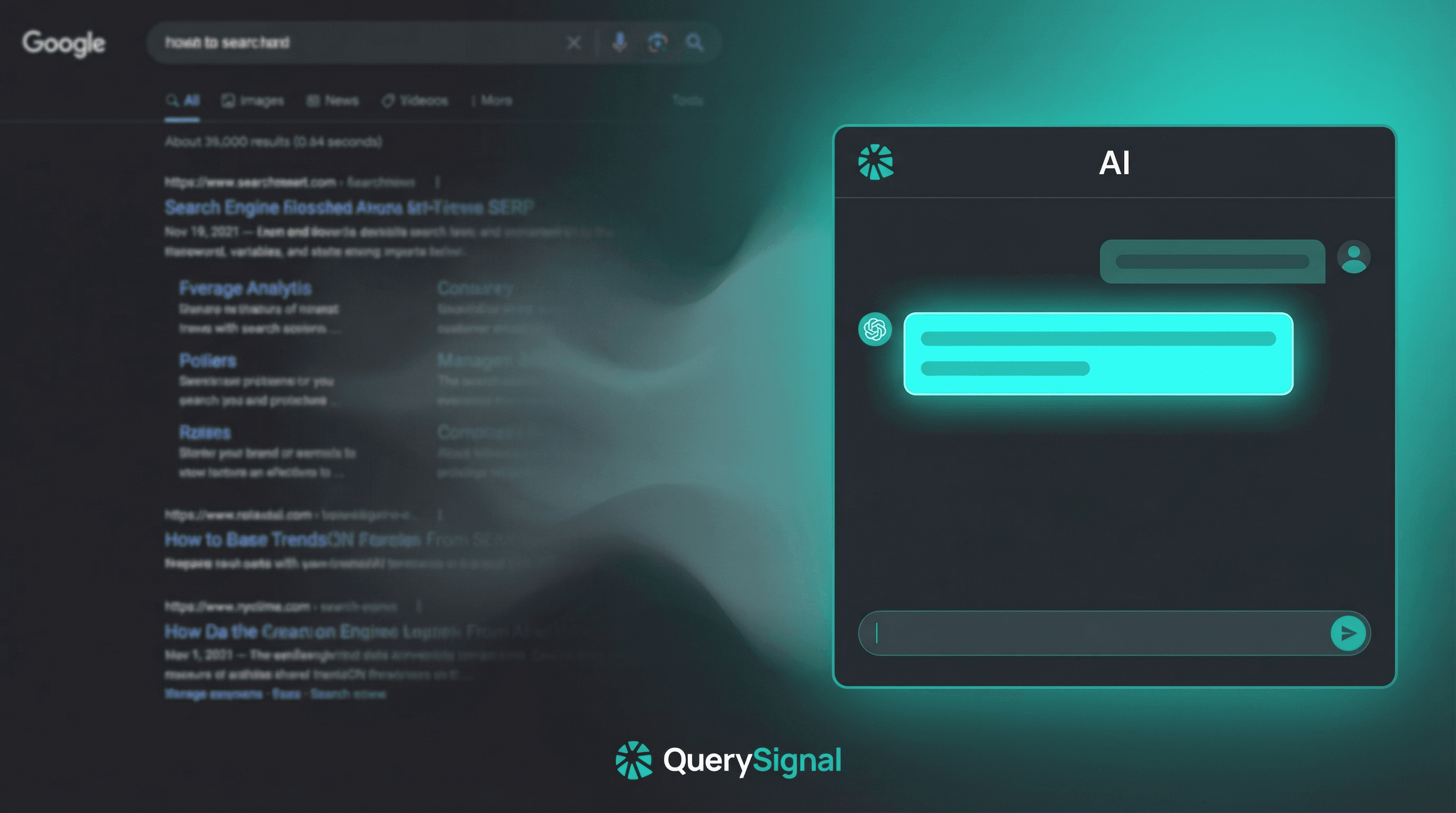
For years, SEO was the dominant playbook for digital growth.
Rank for keywords.
Capture traffic.
Convert visitors.
It worked because search engines showed options. Users compared links, opened multiple tabs, and explored.
That world is disappearing.
AI systems are now the interface between users and information. Instead of browsing pages, people ask questions and receive answers from ChatGPT, Gemini, and Claude.
And those systems do not behave like search engines.
SEO Was Built for Rankings, Not Decisions
SEO optimized for visibility across many results.
The goal was simple:
Appear on page one
Capture a fraction of clicks
Compete on volume
AI search changes the economics completely.
There is no page one.
There is no scroll.
There is no long tail of clicks.
There is a single answer.
That answer carries disproportionate influence because it collapses discovery and decision-making into one moment.
AI Systems Don’t Rank, They Decide
Search engines ranked pages based on relevance and authority.
AI systems synthesize information and decide what to say.
They determine:
Which brands are worth mentioning
Which sources are reliable enough to cite
Which products represent the category
This means visibility is no longer continuous.
It is binary.
You are either mentioned, or you are not.
Introducing Answer Engine Optimization
Answer Engine Optimization, or AEO, is the discipline of optimizing for inclusion inside AI-generated answers.
The objective is not traffic.
The objective is presence.
AEO focuses on:
Being cited as a trusted source
Being named when categories are explained
Being recommended when solutions are requested
This is fundamentally different from SEO.
SEO optimized pages.
AEO optimizes brand authority across the web.
Why Leadership Teams Must Care
This shift cannot be delegated purely to marketing teams.
AI-driven discovery affects:
Brand positioning
Market leadership
Customer trust
Long-term demand
When AI answers questions about your category, it shapes perception before users ever visit your website.
If leadership teams are not involved in how their company appears in AI answers, they are outsourcing strategy to machines they do not control.
Content Alone Is No Longer Enough
Publishing blog posts is not a strategy.
AI systems evaluate:
Consistency of brand mentions
Authority of the sources mentioning you
Alignment between your claims and third-party validation
Sentiment and context around your brand
AEO requires coordination across:
Content
PR
Partnerships
Technical documentation
Distribution
This is not about producing more content.
It is about producing credible signals.
Measuring the Wrong Metrics Creates Blind Spots
Many companies still measure success using:
Keyword rankings
Organic traffic
Page-level impressions
These metrics fail to answer the most important question:
Are AI systems mentioning us when it matters?
Without visibility into AI answers, leadership teams are flying blind while discovery behavior shifts underneath them.
Early Adopters Will Define the Categories
Every platform shift rewards those who adapt early.
SEO created category leaders that dominated for years.
Answer Engine Optimization will do the same.
The companies that:
Track their presence in AI answers
Measure citation share and sentiment
Actively optimize for inclusion
Will become the default answers while others remain invisible.
Final Thought
SEO optimized for a world of pages.
AI has created a world of answers.
Answer Engine Optimization is not the future.
It is already the present.
The only question is whether your brand is part of the answer.